
Your refrigerator is the only appliance in your home that never gets a day off. It runs through the night, through summer heatwaves, and through every party you have ever hosted. So when it starts behaving oddly, most people wait and hope the problem sorts itself out. It rarely does. Small faults grow into compressor failures, and a delayed call to a fridge repair service turns a modest fix into a full replacement.
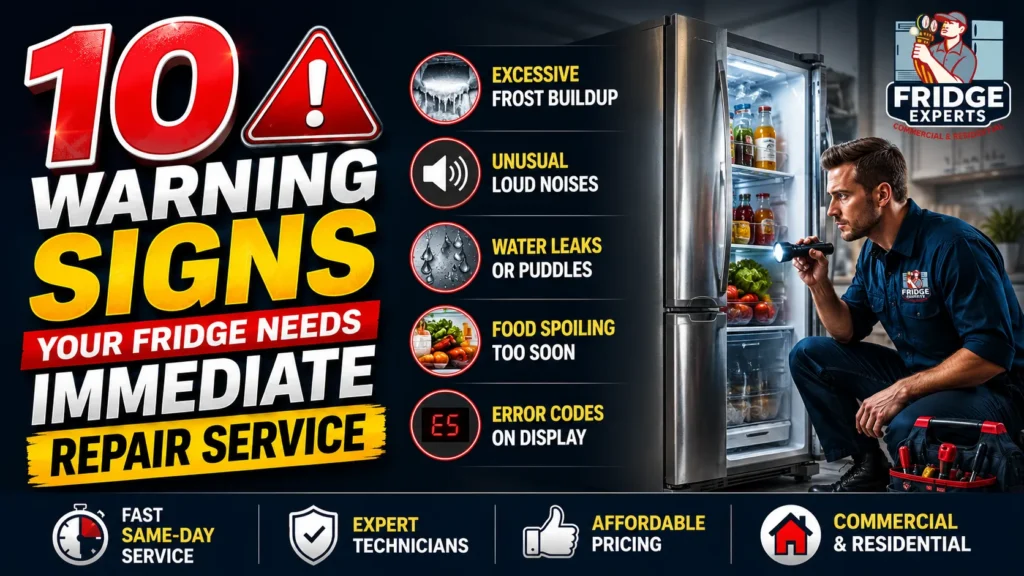
The good news is that fridges warn you first. They get louder, warmer, wetter, or hungrier for power. Below are the ten clearest signals your fridge needs attention now, what each one means, and how to tell a minor annoyance from a genuine emergency.
Why You Should Never Ignore Refrigerator Problems
Immediate fridge repair is needed whenever the internal temperature rises above 5°C, the appliance smells of burning, water is pooling on the floor, or the compressor runs without stopping. Each of those situations either puts your food at risk or strains parts that are expensive to replace.
Refrigerators fail progressively. Dirty condenser coils make the compressor work harder. It then runs hotter, draws more current, wears its start relay, and eventually seizes. Every stage costs more than the one before, which is why urgent fridge repair works out cheaper than a delayed one.
There is a food safety angle too. Bacteria multiply quickly between 5°C and 60°C, so a fridge sitting at 8°C is a health risk, not a mild inconvenience.
1. Your Fridge Isn’t Cooling Properly
This is the most common complaint any fridge technician hears, and the causes range from trivial to serious.
Start simple. Check that the thermostat has not been knocked, that internal vents are not blocked, and that the door closes fully.
If those look fine, the fault is usually mechanical:
- Dirty condenser coils restricting heat release
- A failed evaporator fan that cannot circulate cold air
- Low refrigerant caused by a leak in the sealed system
- A failing compressor that no longer builds pressure
Refrigerant work is legally restricted in Australia, so anything beyond cleaning and airflow checks belongs with a licensed technician.
2. Strange or Loud Noises
A healthy fridge hums, clicks occasionally, and gurgles as refrigerant moves through the lines. Anything sharper deserves attention.
- Loud buzzing often points to the compressor or a failing start relay.
- Rattling usually means a loose compressor mount or a fan blade catching ice.
- Clicking every few minutes suggests the compressor is trying to start and failing.
- Squealing or grinding typically comes from a worn fan motor bearing.
Repeated clicking is the one to treat as urgent fridge repair. Each failed start draws heavy current, and enough attempts will destroy a compressor that a cheap relay could have saved.
3. Water Leaking Around the Refrigerator
Water on the floor is never normal, and it is a slip hazard as well as an appliance problem.
The usual culprits are a blocked defrost drain, a cracked or disconnected ice maker line, or a split drain pan. A blocked drain is often clearable at home, but a leaking sealed system or corroded pan needs professional assessment.
If water is appearing near the power cord or the compressor compartment, switch the appliance off at the wall before doing anything else.
4. Frost Building Up Inside the Freezer
A thin, even layer of frost in a manual-defrost freezer is expected. Thick, uneven ice that returns within days of clearing it is not.
Heavy frost in a frost-free model means part of the defrost system has failed: the heater, the defrost thermostat, or the control timer. Ice then builds on the evaporator coil until air cannot pass through it, which is why frosted freezers so often come with a warm fridge compartment. Chipping that ice away with a knife punctures coils regularly, and it is one of the most expensive DIY mistakes on this list.
5. Food Spoils Faster Than Normal
If milk turns before its date or salad wilts within two days, your fridge is not holding a safe temperature, even if it feels cold to the hand.
Put a thermometer on the middle shelf and check it after a few hours. You want 3°C to 5°C in the fridge and around minus 18°C in the freezer. Anything higher points to a thermostat fault, a sensor issue, poor door sealing, or restricted airflow. If food freezes at the back while spoiling at the front, the problem is circulation rather than cooling capacity.
6. Fridge Runs Constantly
A refrigerator should cycle on and off through the day. Continuous running means it can no longer reach the temperature the thermostat is asking for.
Common causes include clogged coils, a faulty thermostat, worn door seals, a hot room, or refrigerant loss. Whatever the reason, the compressor is under sustained load, and that is what shortens its life. Commercial kitchens feel this first: a display or underbench unit that never cycles off tends to fail mid-service.
7. Burning Smell or Electrical Odours
Treat this as an emergency. A burning, plastic, or acrid smell means wiring insulation, a relay, or a motor winding is overheating.
Switch the appliance off at the power point immediately, and do not run it again to see whether the smell returns. Melting insulation is a fire risk, not a performance issue.
This is the clearest case for urgent fridge repair on the list. Disconnecting the power comes before any troubleshooting.
8. Door Doesn’t Seal Properly
Door gaskets are cheap, easy to overlook, and responsible for a surprising share of cooling complaints.
Test yours with the note trick: close the door on a banknote and pull. If it slides out with almost no resistance, the seal has lost its grip. Look for cracks, hardening, tears, or gaps at the corners, and check the door is not out of alignment on its hinges. A failed seal lets warm, humid air in continuously, driving frost build-up, constant running, higher bills, and faster spoilage at once.
9. Excessive Condensation
Moisture on the inside walls, on shelves, or on the outer door panel signals a humidity problem.
Inside the cabinet, condensation usually traces back to a damaged gasket, a door left ajar, or a blocked drain. Outside, sweating around the door frame can indicate a fault in the anti-condensation heater or, in humid Sydney summers, a tired seal. Left alone, it leads to mould, rust on cabinet edges, and moisture reaching electrical components.
10. Your Energy Bills Suddenly Increase
An unexplained jump in your power bill, with no change in household habits, often traces back to the fridge. It runs twenty-four hours a day, so inefficiency shows up quickly on a quarterly statement. Dirty coils, a stuck defrost heater, a failing thermostat, and worn seals all push consumption up well before the appliance stops working.
When Should You Call a Professional Fridge Technician?
Any of the following calls for urgent fridge repair:
- Burning smells, sparking, or a tripping circuit breaker
- Fridge temperature above 5°C for more than a few hours
- Water pooling near electrical components
- A compressor that clicks repeatedly, runs hot, or will not start
- Ice returning within days of a full defrost
- Any suspected refrigerant leak
Book a standard appointment for worn gaskets, noisy fans, slow cooling, or minor drainage issues. A same day fridge repair booking is worth prioritising if you hold commercial stock or a full freezer.
| Warning Sign | Possible Cause | Urgency Level | Call a Fridge Technician? |
|---|---|---|---|
| Not cooling properly | Coils, fan, refrigerant, compressor | High | Yes |
| Loud or unusual noises | Compressor, relay, fan motor | Medium to High | Yes |
| Water leaking | Blocked drain, cracked line or pan | Medium | Yes, unless a simple drain clog |
| Freezer frost build-up | Defrost heater, thermostat or timer | Medium | Yes |
| Food spoiling early | Thermostat, sensor, airflow, seals | High | Yes |
| Runs constantly | Coils, thermostat, seals, refrigerant | High | Yes |
| Burning or electrical smell | Wiring, relay, motor winding | Emergency | Yes, disconnect power first |
| Door won’t seal | Worn gasket or misaligned hinge | Low to Medium | Optional, replaceable part |
| Excessive condensation | Gasket, drain, humidity control | Medium | Yes |
| Higher energy bills | Coils, defrost fault, seals | Low to Medium | Yes, for a service check |
Can You Fix It Yourself?
Some jobs are genuinely DIY-friendly: vacuuming condenser coils, clearing a blocked defrost drain, levelling the appliance, replacing a door gasket, and reorganising shelves for better airflow.
Other work is not. Anything involving refrigerant, compressors, sealed system parts, or mains wiring requires licensed trade qualifications in Australia. Attempting it risks electric shock, refrigerant burns, and a voided warranty.
The honest rule: if the fix needs a multimeter, a gas gauge, or the removal of a rear panel, hand it to a fridge repair expert.
How Regular Maintenance Prevents Costly Repairs
Most breakdowns are the end point of months of neglect. A short routine prevents most of them.
- Every three months: vacuum the condenser coils and clean the door gaskets with warm soapy water.
- Every six months: flush the defrost drain, check temperatures with a thermometer, and confirm the unit sits level.
- Ongoing: leave a few centimetres of clearance at the back and sides, avoid overpacking shelves, and let hot food cool before it goes in.
- Annually: book a professional service check, especially for commercial fridge repair customers running units under heavy load.
Commercial operators should keep a simple maintenance log. It supports food safety compliance and gives any incoming fridge technician a useful service history.
Final Thoughts
Refrigerators rarely fail without notice. They cool less, run longer, sound rougher, and cost more to operate first. Acting on those signals is the difference between a scheduled repair and an emergency replacement with a fridge full of ruined stock.
If your appliance shows even one of the ten signs above, book a fridge repair service now rather than after the next heatwave. Early diagnosis protects your food, your power bill, and the appliance itself.
Frequently Asked Questions
How long should a refrigerator last before it needs replacing? Most household fridges last roughly ten to fifteen years with reasonable care, and commercial units often less because of heavier use. Age alone is not the deciding factor: a ten-year-old fridge with a failed fan motor is usually worth repairing, while a twelve-year-old unit with a dead compressor generally is not.
Is it safe to keep using a fridge that makes clicking sounds? It is not advisable. Repeated clicking usually means the compressor is trying to start and failing, and every attempt draws a heavy current surge. Booking urgent fridge repair at the clicking stage often saves the compressor altogether.
Why is my fridge cold but my freezer warm? This usually points to a defrost fault or a blocked evaporator. Ice forms on the coil, blocks airflow, and the freezer loses its ability to hold temperature while the fridge stays reasonably cool. It needs diagnosis, not a temperature adjustment.
How much does fridge repair cost in Sydney? It varies with the fault, the parts required, and the appliance type. Gasket replacements and drain clearances sit at the lower end, fan motors and control boards higher, and sealed system work highest. Ask for a diagnosis and quote before work begins so you can weigh repair against replacement.
Can a fridge be repaired the same day I call? Often, yes. Common faults such as thermostats, fans, relays, and gaskets are usually resolved in one visit when the part is on the van. Control boards may need ordering, in which case your technician should tell you the expected wait upfront.
Book a Professional Fridge Repair Service Today
A fridge struggling today will not be cheaper to fix next month. Every extra day of constant running, ice build-up, or failed sealing adds load to the parts that cost the most to replace.
Fridge Experts provides fast, professional refrigerator repairs across Sydney for homes and businesses alike, seven days a week.
📞 Call 0404 705 914 🕖 Open 7 days, 7:00 AM – 7:00 PM 📍 75 Cook Parade, St Clair NSW 2759, Australia
Book your local fridge repair today and keep your food, your stock, and your appliance protected.